abraham.lion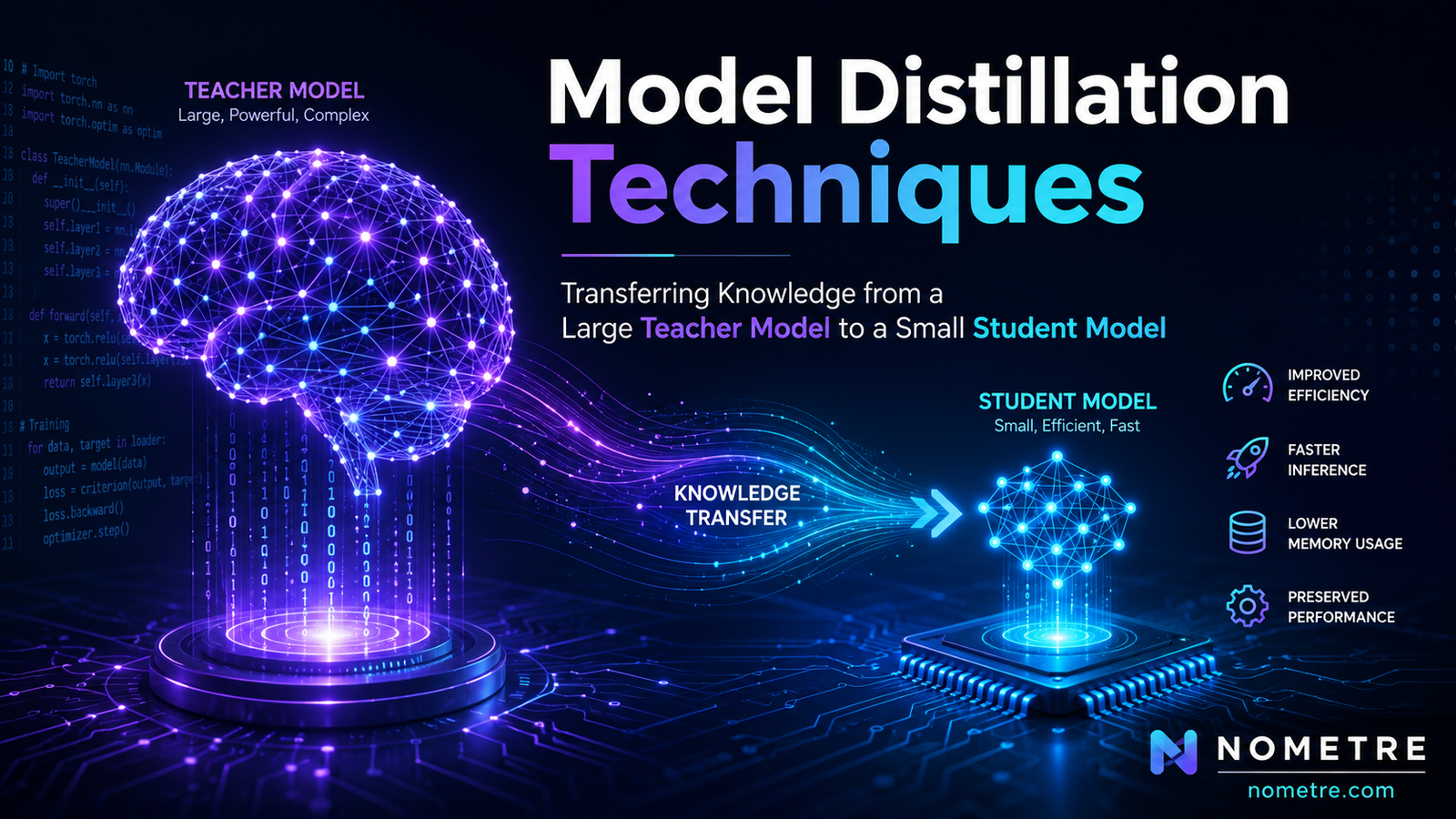
Introduction
Modern machine learning models are getting larger, more capable, and more expensive to run. In many real-world settings, that creates a practical gap: a model may perform well in a research environment, but it might be too slow, too costly, or too resource-heavy for production use. This is where model distillation becomes valuable. Distillation is a method for transferring knowledge from a large, high-performing “teacher” model to a smaller “student” model that is faster and cheaper to deploy. Instead of training the student only on hard labels (for example, the correct class), the student learns from the teacher’s richer output behaviour.
Distillation is widely used in classification, language modelling, and even vision tasks. It helps teams meet latency targets, reduce inference costs, and run models on edge devices, while still retaining much of the teacher’s accuracy. If you are learning these ideas through a data science course, understanding distillation gives you a strong foundation for production-minded ML decisions.
What Model Distillation Actually Transfers
At a high level, the teacher has already learned useful patterns from data. The student’s goal is not to copy the teacher’s internal structure, but to imitate its outputs in a way that captures “dark knowledge”. Dark knowledge refers to the extra information in the teacher’s probability distribution across outputs. For example, in classification, a teacher might assign 0.70 to “cat”, 0.20 to “fox”, and 0.10 to “dog”. Even though “cat” is the correct label, the teacher’s uncertainty reveals relationships between classes. Training on only one-hot labels would hide this nuance.
In language models, the same principle applies. The teacher’s token probabilities can encode grammar, phrasing preferences, and semantic alternatives. By learning these distributions, the student can mimic not only correctness but also the teacher’s “style” of reasoning and generalisation.
Core Distillation Methods You Should Know
Distillation is not a single technique. It is a family of approaches, and the right choice depends on the task and constraints.
1) Logit Distillation (Soft Targets)
This is the most common approach. The student is trained to match the teacher’s output logits or softened probabilities. A temperature parameter is often used to smooth the teacher’s distribution, making it easier for the student to learn. The loss usually combines:
- A standard supervised loss (student vs. ground truth)
- A distillation loss (student vs. teacher outputs)
This combination helps the student remain aligned with real labels while also learning the teacher’s richer behaviour.
2) Feature or Representation Distillation
Instead of copying final outputs, the student matches intermediate representations of the teacher. For deep neural networks, this can mean aligning hidden layers or attention maps. This method is useful when:
- Output distributions are not sufficient to guide learning
- The student needs better internal features for generalisation
However, it requires careful mapping between teacher and student layers, especially when architectures differ.
3) Self-Distillation
In self-distillation, a model teaches a smaller version of itself, or even the same architecture across training stages. Surprisingly, this can improve performance even without a separate, larger teacher. It often works as a form of regularisation, helping the student learn smoother decision boundaries and reduce overfitting.
4) Distillation for Large Language Models
For LLMs, distillation may use:
- Token-level probability matching
- Sequence-level objectives (matching teacher-generated responses)
- Preference or ranking signals (student learns teacher’s choices across candidate answers)
These setups can be designed to optimise factuality, safety, helpfulness, or instruction-following, depending on the teacher.
A Practical Workflow for Distillation in Production
If you want distillation to work in real systems, treat it as an engineering pipeline, not just a training trick.
- Define constraints clearly: latency, memory, cost per 1,000 calls, or device limits.
- Pick a student architecture that fits deployment: smaller transformer, quantised model, or pruned network.
- Choose the distillation signals: logits, features, or teacher-generated outputs.
- Balance losses carefully: too much teacher imitation can reproduce teacher biases; too little loses the benefit.
- Evaluate beyond accuracy: measure calibration, robustness, latency, and failure modes.
- Validate on real traffic patterns: production data often differs from training benchmarks.
This is also why distillation is often discussed in career-oriented learning paths like a data science course in Pune, because employers care about shipping models, not only training them.
Common Pitfalls and How to Avoid Them
Distillation can fail or underperform when teams overlook key details.
- Mismatch between teacher and student domains: If the teacher was trained on a broader dataset, but the student sees a narrow one, the student can inherit confusion. Align datasets carefully.
- Over-reliance on teacher outputs: The teacher may be wrong in edge cases. Keep a supervised component and maintain strong evaluation.
- Poor calibration: Students can become overconfident. Track calibration metrics and consider temperature scaling during evaluation.
- Hidden bias transfer: Distillation can carry over biases present in the teacher. Audit outputs with targeted tests and use diverse evaluation sets.
Conclusion
Model distillation is one of the most practical techniques for turning powerful models into deployable systems. By transferring knowledge from a teacher to a smaller student, teams can achieve better speed and lower cost while keeping strong predictive performance. Whether you use logit distillation, feature matching, self-distillation, or LLM-specific strategies, the key is to treat distillation as a careful balance between learning from truth labels and learning from the teacher’s richer behaviour.
If your goal is to build production-ready skills, distillation is a topic worth mastering because it connects model quality to real-world constraints. It also complements the broader foundations taught in a data science course, where the focus is not only on modelling accuracy but also on how models behave when deployed at scale.
BUSINESS DETAILS:
Name: Data Science, Data Analyst and Business Analyst Course in Pune
Address: First Floor, Sapphire Chambers, Spacelance Office Solutions Pvt. Ltd, 204, Baner Rd, Baner Gaon, Pune, Maharashtra 411069
Email Id: : enquiry@excelr.com
Phone Number: 9945850527


 Anastasiya Yurkevich