SmithJoliya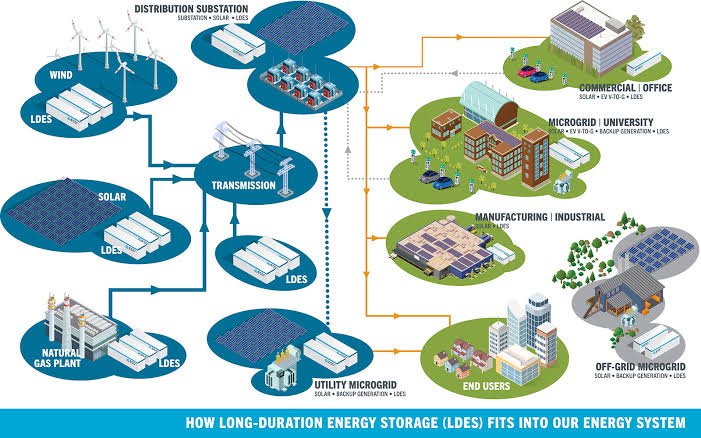
The global transition toward renewable energy is accelerating at an unprecedented pace. Solar panels are blanketing deserts, and massive wind turbines are spinning across coastlines. Yet, behind this green revolution lies a fundamental challenge: nature is inherently unpredictable. The sun does not always shine when electricity demand peaks, and the wind can die down during critical hours.
To achieve a truly zero-carbon future, the world requires a solution that bridges the gap between clean energy generation and round-the-clock consumption. Enter Long-Duration Energy Storage (LDES)—the silent game-changer quietly revolutionizing grid stability and unlocking the full potential of the green transition.
What is Long-Duration Energy Storage (LDES)?
While standard lithium-ion batteries dominate current market headlines—powering everything from electric vehicles to short-term home backup systems—they have distinct limitations. Most conventional battery systems are designed to store and dispatch electricity for 4 to 8 hours.
Long-Duration Energy Storage refers to systems capable of storing energy for tens of hours, days, weeks, or even seasonally, and discharging it back to the grid whenever necessary.
       SHORT-DURATION STORAGE                      LONG-DURATION STORAGE (LDES)
   ┌─────────────────────────────┐             ┌───────────────────────────────────┐
   │ • 1 to 8 Hours Capacity     │             │ • 10+ Hours to Weeks/Seasons      │
   │ • Lithium-Ion Batteries     │     VS      │ • Thermal, Mechanical, Hydrogen   │
   │ • Daily Peak Shaving        │             │ • Multi-Day Grid Reliability      │
   └─────────────────────────────┘             └───────────────────────────────────┘
The Key Characteristics of LDES Systems
-
High Scalability: Designed to hold massive capacities without rapid energy degradation.
-
Low Self-Discharge: Capable of holding stored energy over extended periods without significant power loss.
-
Cost Efficiency at Scale: Cheaper per kilowatt-hour ($/kWh) for high-capacity storage compared to scaling up standard battery arrays.
Why Short-Term Energy Storage Isn’t Enough
LDES ki zaroorat ko sahi tarah samajhne ke liye, hamein modern power grid ki un bunyadi kamzoriyon par nazar dalni hogi jo wind aur solar energy par munhasir hain. Jab grid mukammal taur par qudrati wasail par chalne lagta hai, toh mausam ki tabdiliyan bijli ki farahami ko shdeed mutassir karti hain. Dhoop ka na nikalna ya hawa ka ruk jana pooray taqsimati nizam mein baray paimana par khala paida kar sakta hai. Isi wajah se grid ko bina kisi rukawat ke chalaye rakhne ke liye LDES jaisay mazboot support system ki zaroorat hoti hai. Ye nizam bijli ki shadeed kami aur emergency ke waqt grid ko mukammal baithne se bachata hai.
Grid Congestion and Curtailment
During peak production hours, solar and wind farms frequently generate far more electricity than power grids can safely absorb. Without adequate long-duration storage, operators are forced to turn off clean energy generators—a wasteful practice called curtailment. Long-Duration Energy Storage solves this issue by capturing and retaining every megawatt of surplus green power. Instead of letting clean electricity go to waste, LDES holds it securely until consumer demand surges again. This ensures a zero-waste clean grid that keeps renewable energy available precisely when it is needed most.
Mechanical Storage Technologies
-
Pumped Storage Hydropower (PSH): The oldest and most proven form of storage. Water is pumped to a higher elevation reservoir using excess electricity and released down through turbines to generate power when needed.
-
Compressed Air Energy Storage (CAES): Excess electricity compresses air into underground caverns or pressurized vessels. When energy is required, the compressed air is heated, expanded, and driven through power generators.
-
Gravity-Based Systems: These systems use surplus energy to lift massive concrete blocks or weights high into the air. Releasing the weights lowers them back down, driving kinetic generators.
Thermal Energy Storage (TES)
Thermal storage technology uses excess electricity to store energy as extreme heat or cold. Surplus power heats materials like molten salt, crushed rock, or metals, or freezes liquids into cryogenic states. Later, when energy is needed, this temperature difference produces steam to drive turbines and generate power. This method allows clean energy to be safely held for days or weeks without massive losses. Ultimately, it turns excess renewable energy into a reliable power source whenever demand spikes.
Chemical and Hydrogen Storage
-
Green Hydrogen: Excess clean energy drives water electrolyzers to produce hydrogen gas. This hydrogen can be safely stored in underground salt caverns for months and later burned in specialized turbines or converted back to power via fuel cells.
Advanced Flow Batteries
Unlike standard sealed lithium-ion batteries, flow batteries store electrical energy directly inside large liquid electrolyte tanks. To increase their storage capacity, operators simply need to install larger tanks rather than adding expensive battery cells. This unique separation of energy capacity and power output makes scaling up remarkably flexible and cost-effective. Consequently, flow batteries are becoming an ideal choice for long-duration energy storage across major power grids. They provide a safe, durable, and highly scalable solution for keeping clean power available for days.
The Economic and Environmental Impact of LDES
The integration of long-duration energy storage yields far-reaching advantages across energy markets, local economies, and global climate goals.
| Impact Vector | Primary Advantage |
| Grid Reliability | Eliminates blackout risks during prolonged extreme weather events. |
| Decarbonization | Replaces fossil-fuel “peaker plants” with zero-emission stored energy. |
| Economic Efficiency | Lowers overall energy system costs by preventing curtailment losses. |
| Energy Security | Reduces national dependence on imported fossil fuels. |
By serving as a dependable buffer, LDES transforms weather-dependent energy into a predictable baseload resource—allowing nations to phase out coal and gas power plants safely.
Overcoming Key Challenges to Global Adoption
Despite its immense promise, widespread deployment of LDES faces notable hurdles:
-
High Initial Capital Costs: Setting up large-scale infrastructure like cavern storage or pumped hydro requires significant upfront investment.
-
Market Design Barriers: Many energy markets lack structured financial incentives or long-term contracts for energy providers that supply multi-day storage services.
-
Technology Maturity: Several promising thermal and electrochemical storage formats are still transitioning from pilot testing to full industrial scale.
Addressing these bottlenecks will require targeted government policies, infrastructure subsidies, and modern energy market frameworks.
Ending Note
Long-Duration Energy Storage is far more than a supporting technology; it is the fundamental pillar required to transition from a fossil-reliant grid to a 100% renewable energy future. By bridging the critical gap between generation times and consumer demand, LDES transforms intermittent wind and solar energy into reliable, round-the-clock power. As technological innovations mature and global deployment accelerates, LDES will solidify its place as the definitive, silent game-changer of the modern green transition.
Final Question
How quickly do you think your country’s power grid can transition to 100% renewable energy, and do you believe Long-Duration Energy Storage will be the deciding factor?


 Anastasiya Yurkevich